Pages

Showing posts with label galax tuning. Show all posts

Friday, July 11, 2025

Bumblebee #1-6-12-2025


The Bumblebee-- a dulcimore that tells some history.

This dulcimore I’ve named the Bumblebee isn’t a historical dulcimore, but it’s a dulcimore that tells some history. Keep in mind, especially you historians, I’m just hitting the highlights here in this story, and to speak plainly, before the Galax dulcimore police speak up…… this is NOT a Galax dulcimore!

First of all, the name. Why Bumblebee? German author Wilfried Ulrich explains the German name for Bumblebee is Hummel. So in reality I’m calling this dulcimore a Hummel. The Hummel, as well as the Appalachian Dulcimore have drone strings that you don’t note, and they simply buzz or hum along creating a sound much like a bee. Thus the name drone, which is also another bee analogy.

Just like the Appalachian dulcimore, there were many shapes and sizes of the Hummel. And those shapes and sizes were from different areas. In Appalachia, early Virginia dulcimores were usually teardrop, boat paddle or elliptical shaped, (such as the Bumblebee), and the Kentucky dulcimores are usually hourglass, or as some would say, fiddle shaped, and Tennessee had the music box, which was a square box……….. We find different shapes and sizes in Hummels also. The Czech Hummels, Hungarian Citeras, Frisian Hummels, Friesland Hummels, Saxony Hummels, Epinettes from France, Norwegian Langeleik and many others from other areas.

Secondly, the Bumblebee represents transition. Most of the early Hummels made little sound. Just fine in a quiet setting or playing music for yourself. Along the way they found that if they sat the instrument on a table or plank of wood that the sound would be amplified when they played. Some of the early Hummels even lacked a bottom because the table became the bottom of the instrument when they played. Wilfried Ulrich, in his book: The Story of the Hummel explains: There was an early Hummel that was long and slim and Praetorius, in describing it, called it a Scheitholt…. Which translated means “a piece of wood”. But over time the name stuck and some folks to this day still call it a Scheitholt. Early Pennsylvania Dutch began making these hummels. ( that are still falsely called Sheitholts by a lot Americans) and, somewhere along the way someone realized the could simply make a box that attached to the bottom of the Hummel and get more sound and volume from it, and it would be easier to tote around than having to tote a table along with it. Additionally, a lot of early Hummels had as many as 15 or more strings. The folks that transitioned the Hummel to the top of a sound box decided 3 or 4 strings were plenty. And thus became the Appalachian Dulcimore. Although, some early Appalachians still found the need, or desire, to play their Dulcimore on a table, which can be evidenced by the feet on the bottoms of early dulcimores.

Thirdly, the Bumblebee demonstrates the need, or desire, for more volume from the Dulcimore. In the late 1800’s the Melton family of Galax Virginia began making large dulcimores with soundholes in the bottom and with feet keeping the bottom from touching the table. This amplified the sound even more. Eventually, they went further and attached another back about ¼” distance from the normal back making a resonator of sorts, not unlike the resonator on modern banjos. Perhaps this solved a problem for them that their ancestors had when they invented the soundbox. Those that are familiar with playing a dulcimore know that when the back, or bottom of the dulcimore is touching your legs it deadens the sound somewhat. So the invention of a false back, or more accurately the resonator back, prevented a lot of the sound deadening and gave the Galax folks the much needed volume to play along with fiddles and banjos and not get drowned out, and without the need for playing on a table. Apparently even a century later the Galax folks had no desire to carry around a table in order to be “loud enough”!

So I’ve built the Bumblebee having 6 strings with 4 of them being drone strings to kinda give it the early Hummel vibe and there's many different tunings I can do with it. Also you’ll notice the large fretboard will remind you of an early transitional dulcimore if you’re familiar with those. And I’ve given it the elliptical shape and the resonator back of the Galax Dulcimores.

This specs of particular Bumblebee are:
Top and fretboard: repuposed Red Spruce.
Back, resonator back and sides: Yellow Poplar.
Fingerboard, peghead and tailpiece: Sassafras.
26 inch vsl with tweaked Pythagorean/Equal temperament intonation.
6 strings.
Tuned: D-3rd octave bass and ddddd-4th  octave for the rest of the strings.
Steel staple frets.
Handmade steel tailpiece plate that I rust blued.
Brass bridge, nut, string anchors, and screws for steel plate. 
Blued steel zither pins.
4 coats of Boiled Linseed oil/turpentine.
2 coats of beeswax.


And here's a demo video of the Bumblebee with 3 different string arrangements:


Friday, April 24, 2020

Temperaments

I'd like to say a few things about temperaments.

Over the past year I've kinda been studying a lot and trying to learn as much as possible about the different temperaments. For most modern dulcimer players equal temperament is the go to thing. But a lot of the traditional dulcimore fans prefer and appreciate other temperaments.

For the longest time I was content with equal temperament. That is, until I began mainly focusing on playing Unison tuned dulcimores. To my ear, equal temperament sometimes can be brash, or harsh sounding in unison tuning. In the past, I've had no problems with equal temperament on modal tuned instruments.
But as a whole, I think this generation has been conditioned to the sound and tone of equal temperament to the point that nothing else sounds good or right, even if it is good and right. Our ancestors would likely think our fretting was off if they heard some of our equal temperament dulcimores.
Some dulcimore and dulcimer builders of this age have made custom temperaments that smooth here and there and take the sting out of equal temperament. Which is great! Dulcimore Dan has a custom temperament that works very well in different modes.

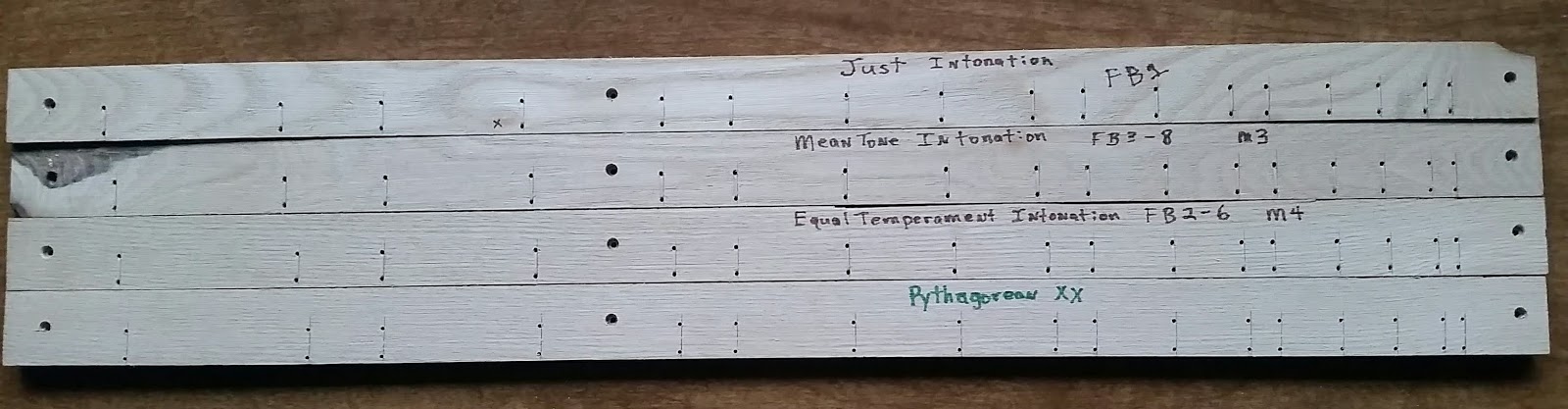
So a few weeks ago I set out to come up with a custom temperament for unison tuning. I built a simple box dulcimore with interchangeable fretboards. I tried several known temperaments including equal temperament and made 4 custom temperaments and the 4th try sounded very good to my ear. However, after trying all of them and working two straight days on them I tried Pythagorean temperament! Wow! It's much better than anything I've tried in unison tuning! And it also sounds great in Ionian mode. I have some more testing to do, but I'm confident it'll work great!

Here's the test dulcimore and some temperament fretboards from the testing:


So here's my thoughts and impressions about the different temperaments. Please keep in mind that everyone has a sound or tone they prefer and my experience may not be yours. Also keep in mind that not all tunings will work well from what your dulcimore are set up with. For instance: If you order a dulcimore set up for Ionian note of D tuning in Just intonation, it may not sound great tuned to Dorian mode. It probably won't be horrible, and will still be playable, but just not excellent like in Ionian.

Equal Temperament:
ET (Equal Temperament) is kinda good at everything as far as I'm concerned. Some folks complain it sounds harsh or brash at times in Ionian mode as it clashes with the drones. That hasn't been my experience but like I said above, everyone don't hear the same. But it does sound harsh or brash to me at times in unison tuning.
ET would be the tuning to go with if you play a lot with others that are playing ET dulcimers or dulcimores. And chances are if they're playing guitars, mandolins, banjos, etc., they're equal temperament. Also, if you record and play several instruments on different tracks you'll probably want ET.
It will sound ok if you're in any of the modal tunings as well if you're playing a unison tuned dulcimore or if you have your unison tuned dulcimore tuned in a minor tuning.
It's actually hard to beat ET for unison tuning or for modal tuning for that matter, especially if you do a lot of re-tuning to different modes. It's not perfect, but it is flexible without sounding horrible.
Additionally, if I could only had one dulcimore, and I frequently re-tuned to play in different modes, I would likely choose ET.

Just Intonation Temperament:
I find JI (Just Intonation) to sound sweet in Ionian mode. I've not experimented with it a great deal in the other modes. But I absolutely do not like it in Unison tuning. However, with my unison tuned dulcimore with the melody strings tuned to "d" and the drones tuned to "e" (minor tuning which is basically Aeolian mode) it does sound fine. But I do know others that say they like it for Unison tuning. Like I said, we all hear differently, but it would be my last choice for Unison tuning.

1/4 comma Mean Tone Temperament:
MT (Mean Tone) seems to be a little more flexible than JI. I've tried it in several modal tunings and also in unison and it's minor tuning. It sounds OK in all of them. I find that I still prefer ET for unison tuning, but I like it better than JI for unison. It also sounds really good in Ionian and Dorian mode. If I had the choice between Just Intonation and Mean Tone Temperament I would go Mean Tone for the flexibility for different Modes, and especially if I were considering a Unison tuned dulcimore.

Pythagorean Temperament:
PT (Pythagorean Temperament) was new to me, but is one of the oldest temperaments. I've found it to sound great to my ears in Unison and in Ionian and Aeolian as well. The best thing I can say about PT is WOW! I'm going to be trying it in other modes as well and the Minor tuning of unison. I'll be doing more testing of this temperament in different modes and tunings soon.
So here's a sound sample of Pythagorean Temperament In Ionian Gdd:
CLICK HERE!
Here's a tune played in Unison tuning dddd:
CLICK HERE!
And here's a sound sample of Aeolian DAc tuning:
CLICK HERE!

UPDATE:
After testing for a few weeks,  to conclude with this post, my go-to temperament will be Pythagorean Temperament on my future builds for myself. It's more smooth sounding and ancient compared to Equal Temperament. It's slightly more flexible if you wish to re-tune to another mode. Not as flexible as Equal Temperament for re-tuning, but more than the other temperaments mentioned above to my ear. I absolutely love PT for my playing style, for Unison tuning, and for Modal Tunings. It sounds well on fast fiddle tunes in Unison tuning as well as in Aeolian mode. It also sounds great on slower tunes played in Ionian mode and Aeolian mode. I find it doesn't sound as nice when playing fast fiddle tunes in Ionian mode, but I have my Unison tuned dulcimores for that. 


Friday, May 24, 2019

Old Virginia Dulcimores and Unison Tuning??

I have a theory, sort of, or a bunch of assumptions about the unison tuning and old Virginia Dulcimores.
It might get dangerous around here!

So with a greater interest in traditional Virginia style dulcimores than dulcimores made in surrounding states, a few months ago something started me to thinking. I've been online looking at photos and gathering information from the few books on Dulcimer history since around 2007, but more so within the past year. I suppose deep down I've been hoping to find a dulcimore that was possibly made in my home county of Buchanan or at least close by, but to no avail.

I've also been gathering info for a new dulcimore I'm naming the Virginian. I wanted to find as much info as possible about their length, width, height, vsl, (vibrating string length). In my quest to find this info a couple things began to stand out. The first was the vsl. If you don't include the specs of the dulcimores made famous in the Galax area by the Melton family beginning around 1900, the average vsl of my findings is about 24 inches.
The other interesting thing I realized by accident was the number of strings of the early Virginia dulcimores. The number of strings....... yes, the number of strings. It seems the older the relics the more of them that had 4 strings and as time went on you gradually begin to find more with 3 strings.
Even the earliest dated dulcimore, the John Scales dulcimore, had 4 strings, equally spaced apart on a narrow fretboard.

So you may ask......... why does this interest me??
It shouldn't actually. I find it hard playing in the unison tuning which is sometimes referred to as Galax tuning due to a mild ear problem makes it hard for me to hear what I'm doing. You see, for those that don't know the Melton family began making this tuning famous by winning competitions. Instead of the modal tunings most players use now-a-days which are something like Daa, Dac, Dad, etc., the Melton family made the unison tuning famous and it's tuned dddd across all 4 strings and used a noter to note the two strings closest to them at once. All 4 of those strings are usually strung with around .012 gauge strings but from my research could be from .009 to .013 depending on the vsl. Whereas generic modern dulcimer strings tuned Daa would be strung with .022, .012, .012 and tuned to Dad would be strung .022, .014, .012.

So with those facts in mind, my my friend Dulcimore Dan Cox explained that most of the Kentucky dulcimores he had examined with old, or possibly original string on them used #4 and #8 music wire which are .013 for #4 and .020 for #8. So that gives us a general idea of at least what they were using in Kentucky.

But with info from viewing photos of vintage Virginia dulcimores, all the strings seem to be of equal size. So you may ask.............. can you really tell that from a photo?
An example: on a 24 inch vsl dulcimore tuned Ionian with around 15 pounds tension, the bass string would be around a .023 diameter string with the middle and melody strings being .015 diameter. Yes, I could pretty much tell that in a photo. There is a thought that most of the old dulcimers were likely tuned Cgg instead of Daa, but still, with the dulcimore tuned Cgg that would likely make it just as easy to tell with the bass string being .026 and the middle and melody being .017 diameter assuming the were around 15 pounds tension.

So lets assume for a bit the strings were all the same size. And let's assume the older dulcimers were tuned to what a lot of people think was THE tuning back then........ C. Assuming they were tuned cccc all across the 4 strings and let's say around 12-15 pounds tension, that would give us around .012 to .013 diameter string. I think if you looked at the photos closely you could probably agree those sizes are in the ball park.
But couldn't you tune it to Ionian with those gauges?
Here's where it really helps make my mind up about the unison tuning.
In order to make those 4 strings be tuned in Ionian tuning C you need to tune 3 of those strings to G.
Here's what you get with 4 strings of .013 diameter:
C-4th octave= .013 @ 15# tension at 31% breaking tension. (Meaning it has around 69% before it breaks)
g-4th octave= .013 @ 35# tension at 69% breaking tension. (!!!)
g-4th octave= .013 @ 35# tension at 69% breaking tension.

So you can see the tension of the strings tuned to G is much too high! So with your noter you would be pressing down 70 pounds of tension on the double melody strings.

Another scenario:
C-4th octave= .013 @ 15# tension at 31% breaking tension. (Meaning it has around 69% before it breaks)
G-3rd octave= .013@ 8# tension at only 17% breaking tension.

In theory this would be more possible due to the lighter pressure on the two G strings, but I tried it. It is a mess to try and play due to the 3 strings tuned to a 3rd octave G at only 8# being so slack and it's just not enough tension.

Scenario 3:
C- 4th octave= .015@ 20# tension at 31% breaking tension.
G- 3rd octave= .015@ 12# tension at only 18% breaking tension.

Scenario 3 would be the most likely and logical scenario if they tried using one string diameter over all 4 strings tuned in an Ionian tuning. A .015 or .016 diameter string would be more of a middle ground size to cover both C and G, even though it puts the C at a higher octave than the 3 G strings which makes it kinda out of line with our way of thinking today, which would most of the time put the lower ocatve on the bass string  and the higher octave on the middle and melody strings.

So why would they even use the same size string on all 4 strings?
It could be a couple things-
(1) availability. Was it because the early times of development of the country not having stores which supplied multiple sizes of music wire or wire in general?
We know music wire was around then. But I suppose it was a item used for hardware supplies more than music instruments. Even today you can't readily buy any kind of music instrument strings in the county I live in. I suspect back then they simply went to a hardware store and bought some music wire that most people just used to hang pictures or used for general use around the farm and strung a dulcimore with it. Likely the hardware store did not stock several sizes either. So because of availability they were forced to find a tuning they could play with one size wire.
(2) Tradition. I also figure that more than likely this tuning had been passed down from kin folk that had used it on their dulcimores or the  ancestor to the dulcimores...... zithers and such, and they kept using it until the lack of popularity rooted it out.
(3) Maybe it was a little or a lot of both the reasons mentioned above. But after much debate with myself I think it's more so along the lines of the second reason. It would not have been impossible for the builders or owners to order a spool of music wire in the correct diameter they needed and it would likely last for years for personal use. Which raises another question: If they could order wire why not just order two correct sizes if they used modal tunings? We will likely never know if that's the case, but I still think it's a traditional tuning passed down from long before the Melton family made it famous.

As I said in the first sentence............ it's just a theory based on a bunch of assumptions. But I believe the unison tuning was played throughout early dulcimore history right along side the modal tunings, or it's very possible, it was the earliest tuning at least in Virginia and what is now southern West Virginia. I have absolutely no way of proving this. But I honestly think the Melton family did not invent unison tuning. But more likely they were playing in a tuning that had been around 75 years or longer when they made it famous.

This is not a jab at the Meltons or a jab at anyone who believes or thinks otherwise. It's just a theory from the little evidence I've come across.

Edit: 6/8/2019- Recently another clue has come to light. I have been playing my new unison tuned dulcimore often and I noticed something. 14 frets, as a lot of vintage dulcimores from surrounding areas had, would not be sufficient for playing some tunes on the higher octave of the fretboard. So my new research is concentrating on how many frets the vintage Virginia dulcimores had.
With very little research I'm finding a lot of 4 string equidistant string spacing Virginia examples having 15, 16 and 17 frets.
I think this is more proof that unison tuning was around since the beginning of the Virginia dulcimore.
I will continue my quest to prove my theory.