Pages

Showing posts with label custom temperament. Show all posts

Tuesday, July 15, 2025

Tignor Traditional Replica #1 coming soon!


This will be my next build.  A John D. Tignor traditional replica.

One thing I know is, I know I don't make every dulcimore of the same model exactly alike. And I've heard a few of you other builders also state they same. We simply do not make cookie cutter dulcimores!

Well, John D. Tignor definitely did not either! But in his defense, I could only find 4 measurements of his true traditional pieces, and one measurement of his early traditional body dulcimores with the modern frets and wider fretboard. So it's possible he could have made a bunch of them pretty close to the same pattern, because he sorta did with his semi-modern pieces, but I think he was still trying to find his way on his early traditional staple fret models.
I got some actual measurements that Dulcimore Dan Cox and John Halberg provided me, and I got photograph measurements by blowing up photos to match a known measurement such as side height, fretboard width or VSL or all the above.
The numbers were all over the place! Far from being identical in measurement, and also how far the bouts were from the ends, etc.

John Halberg provided me with photos and measurements of John D. Tignor #1. And some of you might wonder why I did not simply just use those for my pattern???
Just as my work, or any other builder for that matter, your first build most likely does not define the entirety of your life's work. My dulcimore building is a far cry from my first one, and so are my designs.
The John D. Tignor #1 is basically a crude copy of a Jethro Amburgey. Eventually you can see differences he made as he began going away from the Thomas Design. Most notably the length and design on his end blocks where his early traditional staple fret models are concerned. And I can also tell that some of his design stuff was to basically simplify something, and some of the design is pure confusion to me wondering why the tarnation did he do that?

So what I've done is I've decided to use his later long endblock design rather than the design of his Amburgey style #1 dulcimore. And the measurements for the lower and upper bout widths, the width of the waist, and the distance of the bouts from the ends are all averages of the pieces I was able to get measurements of. So this is not a direct copy of any one John D. Tignor traditional dulcimore, but it's a close copy to all of them.

Check back to see what the finished dulcimore looks like and thanks for visiting!


Friday, July 11, 2025

Bumblebee #1-6-12-2025


The Bumblebee-- a dulcimore that tells some history.

This dulcimore I’ve named the Bumblebee isn’t a historical dulcimore, but it’s a dulcimore that tells some history. Keep in mind, especially you historians, I’m just hitting the highlights here in this story, and to speak plainly, before the Galax dulcimore police speak up…… this is NOT a Galax dulcimore!

First of all, the name. Why Bumblebee? German author Wilfried Ulrich explains the German name for Bumblebee is Hummel. So in reality I’m calling this dulcimore a Hummel. The Hummel, as well as the Appalachian Dulcimore have drone strings that you don’t note, and they simply buzz or hum along creating a sound much like a bee. Thus the name drone, which is also another bee analogy.

Just like the Appalachian dulcimore, there were many shapes and sizes of the Hummel. And those shapes and sizes were from different areas. In Appalachia, early Virginia dulcimores were usually teardrop, boat paddle or elliptical shaped, (such as the Bumblebee), and the Kentucky dulcimores are usually hourglass, or as some would say, fiddle shaped, and Tennessee had the music box, which was a square box……….. We find different shapes and sizes in Hummels also. The Czech Hummels, Hungarian Citeras, Frisian Hummels, Friesland Hummels, Saxony Hummels, Epinettes from France, Norwegian Langeleik and many others from other areas.

Secondly, the Bumblebee represents transition. Most of the early Hummels made little sound. Just fine in a quiet setting or playing music for yourself. Along the way they found that if they sat the instrument on a table or plank of wood that the sound would be amplified when they played. Some of the early Hummels even lacked a bottom because the table became the bottom of the instrument when they played. Wilfried Ulrich, in his book: The Story of the Hummel explains: There was an early Hummel that was long and slim and Praetorius, in describing it, called it a Scheitholt…. Which translated means “a piece of wood”. But over time the name stuck and some folks to this day still call it a Scheitholt. Early Pennsylvania Dutch began making these hummels. ( that are still falsely called Sheitholts by a lot Americans) and, somewhere along the way someone realized the could simply make a box that attached to the bottom of the Hummel and get more sound and volume from it, and it would be easier to tote around than having to tote a table along with it. Additionally, a lot of early Hummels had as many as 15 or more strings. The folks that transitioned the Hummel to the top of a sound box decided 3 or 4 strings were plenty. And thus became the Appalachian Dulcimore. Although, some early Appalachians still found the need, or desire, to play their Dulcimore on a table, which can be evidenced by the feet on the bottoms of early dulcimores.

Thirdly, the Bumblebee demonstrates the need, or desire, for more volume from the Dulcimore. In the late 1800’s the Melton family of Galax Virginia began making large dulcimores with soundholes in the bottom and with feet keeping the bottom from touching the table. This amplified the sound even more. Eventually, they went further and attached another back about ¼” distance from the normal back making a resonator of sorts, not unlike the resonator on modern banjos. Perhaps this solved a problem for them that their ancestors had when they invented the soundbox. Those that are familiar with playing a dulcimore know that when the back, or bottom of the dulcimore is touching your legs it deadens the sound somewhat. So the invention of a false back, or more accurately the resonator back, prevented a lot of the sound deadening and gave the Galax folks the much needed volume to play along with fiddles and banjos and not get drowned out, and without the need for playing on a table. Apparently even a century later the Galax folks had no desire to carry around a table in order to be “loud enough”!

So I’ve built the Bumblebee having 6 strings with 4 of them being drone strings to kinda give it the early Hummel vibe and there's many different tunings I can do with it. Also you’ll notice the large fretboard will remind you of an early transitional dulcimore if you’re familiar with those. And I’ve given it the elliptical shape and the resonator back of the Galax Dulcimores.

This specs of particular Bumblebee are:
Top and fretboard: repuposed Red Spruce.
Back, resonator back and sides: Yellow Poplar.
Fingerboard, peghead and tailpiece: Sassafras.
26 inch vsl with tweaked Pythagorean/Equal temperament intonation.
6 strings.
Tuned: D-3rd octave bass and ddddd-4th  octave for the rest of the strings.
Steel staple frets.
Handmade steel tailpiece plate that I rust blued.
Brass bridge, nut, string anchors, and screws for steel plate. 
Blued steel zither pins.
4 coats of Boiled Linseed oil/turpentine.
2 coats of beeswax.


And here's a demo video of the Bumblebee with 3 different string arrangements:


Friday, April 24, 2020

Temperaments

I'd like to say a few things about temperaments.

Over the past year I've kinda been studying a lot and trying to learn as much as possible about the different temperaments. For most modern dulcimer players equal temperament is the go to thing. But a lot of the traditional dulcimore fans prefer and appreciate other temperaments.

For the longest time I was content with equal temperament. That is, until I began mainly focusing on playing Unison tuned dulcimores. To my ear, equal temperament sometimes can be brash, or harsh sounding in unison tuning. In the past, I've had no problems with equal temperament on modal tuned instruments.
But as a whole, I think this generation has been conditioned to the sound and tone of equal temperament to the point that nothing else sounds good or right, even if it is good and right. Our ancestors would likely think our fretting was off if they heard some of our equal temperament dulcimores.
Some dulcimore and dulcimer builders of this age have made custom temperaments that smooth here and there and take the sting out of equal temperament. Which is great! Dulcimore Dan has a custom temperament that works very well in different modes.

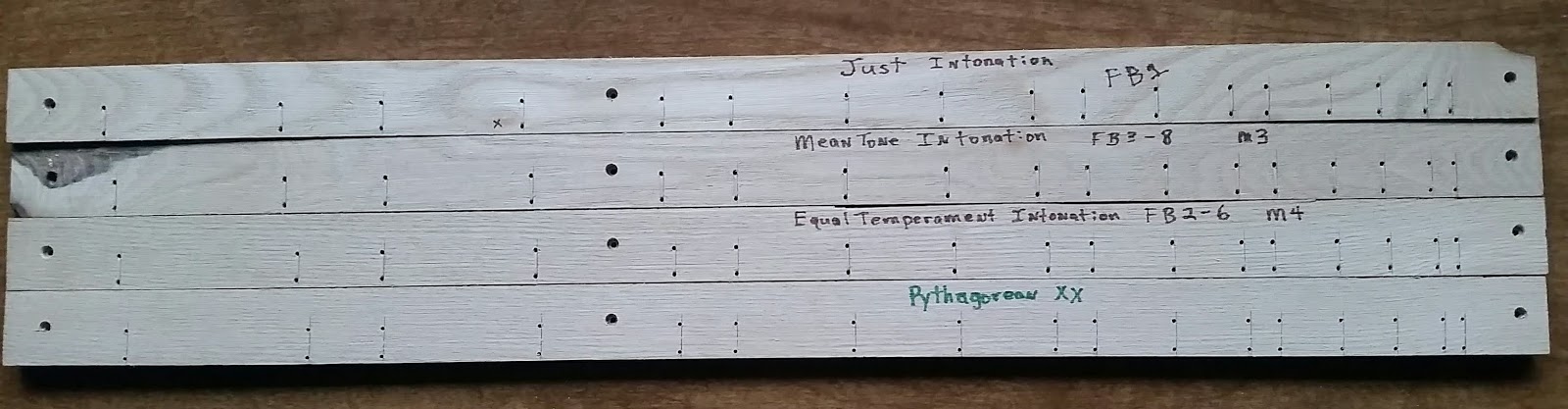
So a few weeks ago I set out to come up with a custom temperament for unison tuning. I built a simple box dulcimore with interchangeable fretboards. I tried several known temperaments including equal temperament and made 4 custom temperaments and the 4th try sounded very good to my ear. However, after trying all of them and working two straight days on them I tried Pythagorean temperament! Wow! It's much better than anything I've tried in unison tuning! And it also sounds great in Ionian mode. I have some more testing to do, but I'm confident it'll work great!

Here's the test dulcimore and some temperament fretboards from the testing:


So here's my thoughts and impressions about the different temperaments. Please keep in mind that everyone has a sound or tone they prefer and my experience may not be yours. Also keep in mind that not all tunings will work well from what your dulcimore are set up with. For instance: If you order a dulcimore set up for Ionian note of D tuning in Just intonation, it may not sound great tuned to Dorian mode. It probably won't be horrible, and will still be playable, but just not excellent like in Ionian.

Equal Temperament:
ET (Equal Temperament) is kinda good at everything as far as I'm concerned. Some folks complain it sounds harsh or brash at times in Ionian mode as it clashes with the drones. That hasn't been my experience but like I said above, everyone don't hear the same. But it does sound harsh or brash to me at times in unison tuning.
ET would be the tuning to go with if you play a lot with others that are playing ET dulcimers or dulcimores. And chances are if they're playing guitars, mandolins, banjos, etc., they're equal temperament. Also, if you record and play several instruments on different tracks you'll probably want ET.
It will sound ok if you're in any of the modal tunings as well if you're playing a unison tuned dulcimore or if you have your unison tuned dulcimore tuned in a minor tuning.
It's actually hard to beat ET for unison tuning or for modal tuning for that matter, especially if you do a lot of re-tuning to different modes. It's not perfect, but it is flexible without sounding horrible.
Additionally, if I could only had one dulcimore, and I frequently re-tuned to play in different modes, I would likely choose ET.

Just Intonation Temperament:
I find JI (Just Intonation) to sound sweet in Ionian mode. I've not experimented with it a great deal in the other modes. But I absolutely do not like it in Unison tuning. However, with my unison tuned dulcimore with the melody strings tuned to "d" and the drones tuned to "e" (minor tuning which is basically Aeolian mode) it does sound fine. But I do know others that say they like it for Unison tuning. Like I said, we all hear differently, but it would be my last choice for Unison tuning.

1/4 comma Mean Tone Temperament:
MT (Mean Tone) seems to be a little more flexible than JI. I've tried it in several modal tunings and also in unison and it's minor tuning. It sounds OK in all of them. I find that I still prefer ET for unison tuning, but I like it better than JI for unison. It also sounds really good in Ionian and Dorian mode. If I had the choice between Just Intonation and Mean Tone Temperament I would go Mean Tone for the flexibility for different Modes, and especially if I were considering a Unison tuned dulcimore.

Pythagorean Temperament:
PT (Pythagorean Temperament) was new to me, but is one of the oldest temperaments. I've found it to sound great to my ears in Unison and in Ionian and Aeolian as well. The best thing I can say about PT is WOW! I'm going to be trying it in other modes as well and the Minor tuning of unison. I'll be doing more testing of this temperament in different modes and tunings soon.
So here's a sound sample of Pythagorean Temperament In Ionian Gdd:
CLICK HERE!
Here's a tune played in Unison tuning dddd:
CLICK HERE!
And here's a sound sample of Aeolian DAc tuning:
CLICK HERE!

UPDATE:
After testing for a few weeks,  to conclude with this post, my go-to temperament will be Pythagorean Temperament on my future builds for myself. It's more smooth sounding and ancient compared to Equal Temperament. It's slightly more flexible if you wish to re-tune to another mode. Not as flexible as Equal Temperament for re-tuning, but more than the other temperaments mentioned above to my ear. I absolutely love PT for my playing style, for Unison tuning, and for Modal Tunings. It sounds well on fast fiddle tunes in Unison tuning as well as in Aeolian mode. It also sounds great on slower tunes played in Ionian mode and Aeolian mode. I find it doesn't sound as nice when playing fast fiddle tunes in Ionian mode, but I have my Unison tuned dulcimores for that.